
Compare Oceana County Property Values
Michigan property records separate several valuation concepts from one another. Preserve the field name and the year, because the word "value" alone hides the reason each number exists.
| Value | What It Is | Where |
|---|---|---|
| True cash value | Michigan's estimate of the property's usual selling price | Local assessment roll or parcel card |
| Assessed value / SEV | Generally 50 percent of true cash value after equalization | Local assessor and BS&A |
| Taxable value | The capped base used with millage rates to calculate tax | Local assessor and BS&A |
| Last sale or consideration | A recorded transfer figure that may or may not reflect an open-market sale | Register deed and parcel card |
| Land and improvements | Separate components when the public card exposes the valuation breakdown | Local assessor or detailed parcel card |
Michigan law sets true cash value at the usual selling price. The assessment framework then splits into assessed value, state equalized value, and taxable value. Those figures can move on different schedules. A transfer may change taxable treatment in the following calendar year. A deed's consideration may describe a transaction that never faced the open market. No field in the property records predicts the exact price today. It cannot tell what a willing buyer would pay.
Look Up Oceana County Property Value
Begin with BS&A Oceana County and choose Assessing or All Records. Search by address or parcel number. Confirm the right municipality before opening a record. A postal place like Hart, Shelby, or Pentwater does not always identify the assessing jurisdiction. An address can sit in a surrounding township. The parcel ID and legal description are stronger match keys than the city line alone. The official BS&A municipality page shows where assessing and detailed records begin.
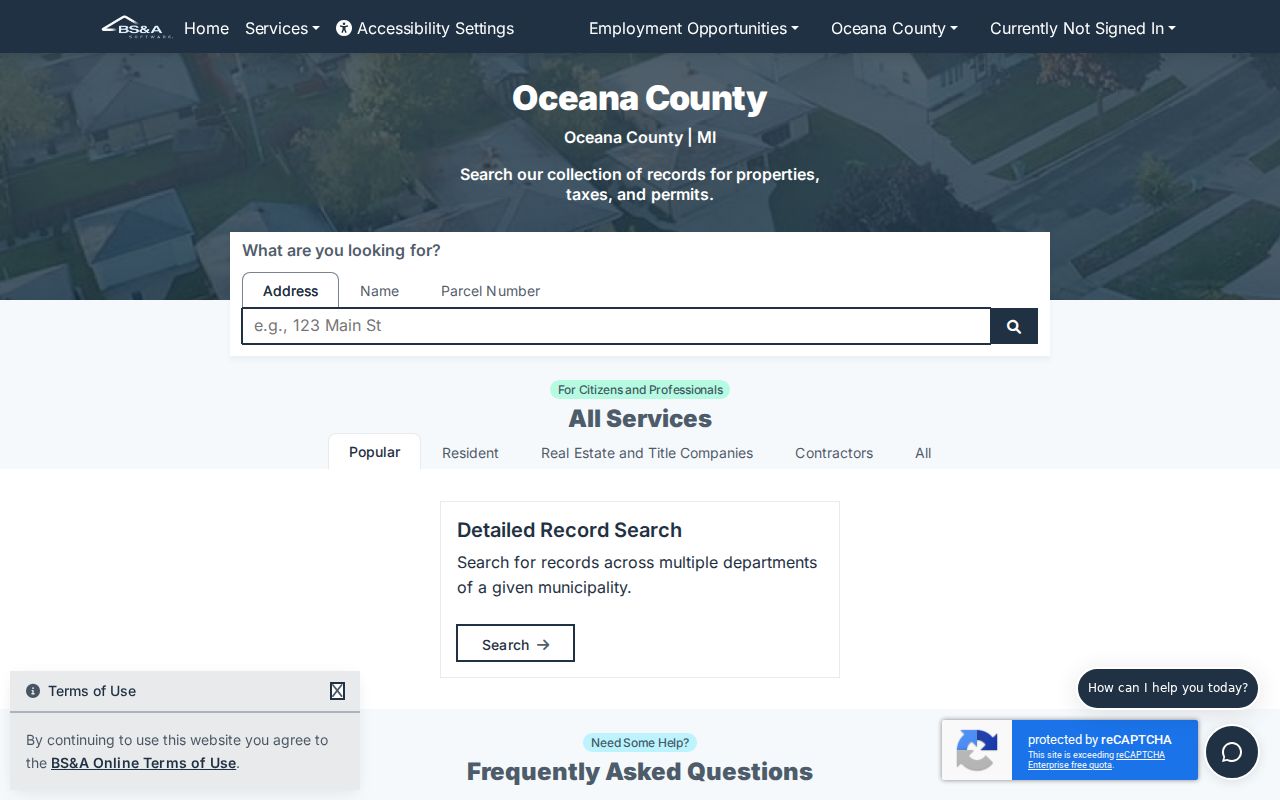
The official page ties value research to the assessing category and municipality context. It does not treat every result as the same valuation record. Copy the label, amount, tax year, and status together. A proposed or tentative figure cannot safely be compared with an unlabeled number from another year. The card may also show classification, acreage, and exemption status. It can include building detail, transfer information, and a map link. A field missing from the public view does not prove it is absent. The official roll may still hold it.
- Save the parcel ID, situs, municipality, class, and assessment year.
- Record true cash, assessed or SEV, and taxable fields exactly as displayed.
- Capture exemptions, transfer date, and last-sale fields only when the card shows them.
- Check the recorded deed for consideration or transfer clues, while noting that not every transfer reflects an open-market sale.
- True cash value
- The Michigan statutory concept for usual selling price, estimated through mass appraisal.
- Assessed value
- The local assessor's valuation, generally one-half of true cash value before equalization.
- State equalized value
- The assessed value after county and state equalization, commonly shortened to SEV.
- Taxable value
- The separate capped tax base used to calculate property tax with applicable millage.
- Level of assessment
- The relationship between assessed value and true cash value; Michigan generally uses 50 percent.
Separate Oceana County Value Fields
Assessed value, SEV, and taxable value each do different work. Local assessors estimate true cash value and place an assessed value on the roll. County and state equalization then produce the SEV. Taxable value follows Michigan's Proposal A framework. It can sit below SEV on the same card. That gap alone is not an error. For property staying with the same owner of record, annual taxable-value growth is generally capped at statutory inflation. Additions and losses adjust the result. The cap applies to taxable value only, not to true cash value or SEV. New construction, demolition, parcel changes, and corrections can therefore shift the displayed fields in different ways. Compare like years and note any additions or losses before drawing a trend. A transfer of ownership generally uncaps taxable value in the next calendar year. Statutory exceptions apply. Uncapping does not mean the assessor copies the sale price. It means the cap resets under Michigan law, commonly to the SEV for that year. The deed date, recording date, transfer date, and tax year can all differ. Save each one rather than calling them a single sale date. Exemptions can change the taxable record without changing the physical property. Never infer condition or a likely offer from it. For the tax bill, due dates, exemptions, or the appeal path, one page covers all of it. See the Oceana County property tax records page.
Match Oceana County Sales to Deeds
The Register's advanced index searches party, grantor, grantee, document type, and document number. It also reaches book or liber and page and legal text. Open the deed itself. Compare its legal description to the assessment parcel before treating any consideration as a value clue. The index is a finding tool. The instrument image or official copy supplies the context needed to interpret the transaction. Family, fiduciary, trust, quitclaim, tax, sheriff, and court transfers may not represent a market exchange. Land-contract transfers may not either. Report the deed type and parties. Do not turn every transfer amount into a comparable sale. A transfer-tax statement also needs its instrument context. Michigan Form 2705 may be used when consideration is not stated. It may also be used when certain entity interests transfer. So an absent deed price does not mean no valuation information exists. The parcel card's last-sale field is a useful cross-check but still an administrative field. Match it to the instrument number and legal description. If dates or figures disagree, report both with their sources. Never silently pick the higher, newer, or more plausible number.
Interpret Oceana County Land History
Oceana County moved from lumber to farms, orchards, asparagus, and resort trade. That shift gives you useful vocabulary for searches. Old atlases, newspapers, assessor classifications, and dated legal descriptions all use terms tied to that land history. The history itself proves nothing about one parcel. It cannot show that a given parcel held any single use. It also cannot show that a historic use lifts current worth.
Put dated fields side by side. Compare classification, improvements, acreage, and transfer history with old maps or permits. An aerial photo helps too. It may reveal trees, cleared ground, shoreline, or structures on the parcel. Yet no photo fixes a build date, proves compliance, settles ownership of record, or sets value. Only a supporting record can do that.
Classification still matters. It explains why two nearby property records compare poorly. Agricultural, residential, commercial, timber, and resort uses carry different land traits and improvements. Treat countywide history as context only. Before framing any value change, confirm the parcel's dated class and the actual card fields.
Align Oceana Value Dates
A solid Oceana County property value note carries three dates at minimum. Include the deed recording date. Also include the effective year of the assessment roll or card, and the tax year when transfer uncapping may apply. Michigan guidance flags a common trap. The transfer date often differs from the date the Register records the deed. A fresh deed record can appear before the assessor's owner field catches up. The taxable value can lag too.
Date every source separately. Name the latest recorded conveyance as of the deed-search date. Then name the assessor values for a stated roll year. If a transfer occurred, check the next year's taxable value on its own. This practice resolves apparent conflicts. Neither office made a mistake. The systems simply update on their own clocks.
Note: County and vendor systems refresh at different times. Keep the source URL, search date, parcel number, and visible status.
Separate Value from Review Status
An assessment notice adds another layer to property records. So does a Board of Review filing or a Michigan Tax Tribunal case. The local board usually comes first. It handles review of valuation, classification, exemptions, and principal-residence questions. A pending challenge never erases the figure on the assessment card. The card alone also cannot show that every appeal has closed.
Track appeals with care. Record the assessed year, the disputed field, the decision date, and the resulting tax roll entry. Tie the decision to the right parcel by number and legal description. That discipline keeps a proposed or contested Oceana County property value apart from a final one. It also stops the analysis from drifting into tax-bill payment matters.
Limit Oceana County Assessed Value Claims
An assessor value is a mass-appraisal figure built for public administration. It is not a parcel-specific appraisal. It cannot serve a sale, loan, estate, or court dispute on its own. It may also rest on a different date than a recent deed record, a later improvement, a demolition, a split, or a change in condition.
Check the roll year and status first. Inspect the matched parcel carefully. When you need a current market opinion, hire a qualified appraiser. The public card may label a figure as current, prior, proposed, final, or historical. Keep those labels straight. Never present every value as simultaneous.
Value is not a sale appraisal. An Oceana County assessor value is a mass-appraisal record, not a guarantee of what the parcel will sell for. A sale, loan, estate, or court matter may require a qualified appraiser's parcel-specific opinion.