
Read Oceana Deeds by Instrument Type
The Oceana Register of Deeds records real-property instruments and keeps the public index. Labels matter here. A deed conveys an interest, yet a mortgage, lien, discharge, easement, plat, or probate order can shape the same parcel without being a sale at all. Open the image before trusting the index label alone.
| Deed Type | What It Does | Common Use |
|---|---|---|
| Warranty deed | Conveys the stated interest with deed covenants | Recorded sale |
| Quitclaim deed | Conveys whatever interest the grantor holds | Family transfer or title cleanup |
| Fiduciary deed | Shows a representative acting in a stated capacity | Estate or trust administration |
| Land contract | Records a contractual land interest | Installment transaction trail |
| Sheriff or tax deed | Documents a process-based conveyance | Foreclosure or completed tax transfer research |
Pair the deed with any releases or corrections filed against it. One transfer document never proves that earlier mortgages, easements, restrictions, or liens were resolved.
Oceana Public Search Filters the Deed Index
The quick Public Search lets you filter by department, search term, recorded-date range, date shortcuts, and either index-only or index-plus-OCR results. Its certification currently runs through August 31, 2026. The January 1, 1800 date floor is just an interface boundary, so treat it as no promise that every early deed is indexed or imaged.
| Control | Available search | Best use |
|---|---|---|
| Party role | Party, grantor, or grantee | Separate transferor from recipient |
| Record key | Document number, book/liber, page | Retrieve a known citation |
| Document class | Deed, mortgage, easement, lien, plat, release, and more | Narrow a long party history |
| Legal text | Freeform, subdivision, section, condominium | Find land after party names change |
| OCR | Phrase text | Find language not cleanly indexed |
The captured advanced deed-index screen shows party, book/page, document type, OCR, and legal-search controls.
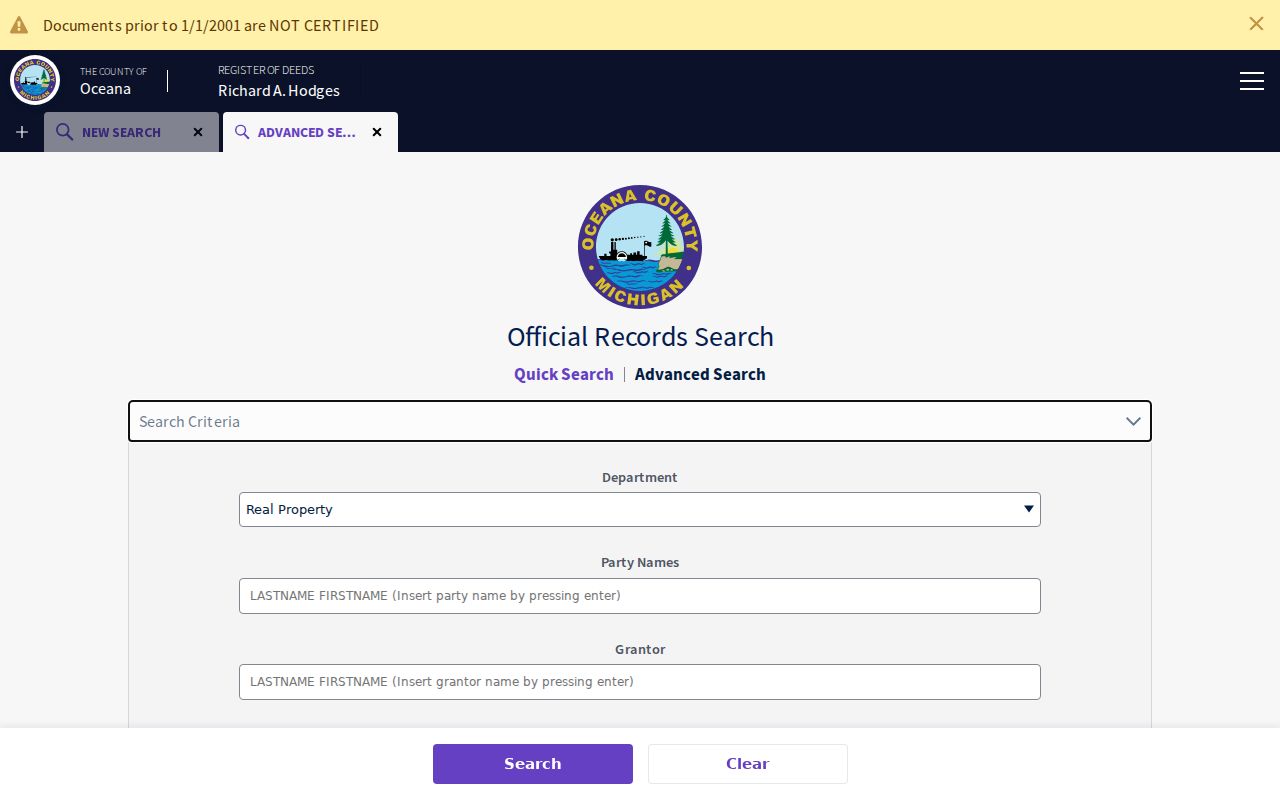
The screen shows an Oceana deed search moving from a name to a recorded citation or subdivision. A modern address is not required to reach the right instrument.
Build an Oceana County Grantor-Grantee Chain
Start with the latest known grantee and open that deed. Write down both parties and their capacities. Include the document type, instrument number, recording date, book and page when assigned, and the full legal description. Then search that grantor as a grantee to find how the parcel was acquired. Keep repeating while the land description stays consistent.
- Identify the current party and exact parcel description.
- Search that party as grantee and open the newest plausible deed.
- Record the grantor, date, capacity, instrument key, and legal description.
- Search that grantor as a grantee for the earlier acquisition.
- Repeat backward and mark every gap or description change.
Names hide in plain sight. Try initials, reversed surname order, married names, trust wording, LLC punctuation,
and personal-representative terms, and fall back on OCR or legal-text search when the party field comes up empty.
- Grantor
- The party shown as conveying an interest.
- Grantee
- The party shown as receiving that interest.
- Chain of title
- The linked sequence of conveyances for the same land.
- Book/page or instrument number
- The recorded citation used to identify a document.
Older Oceana Deeds Leave the Web
Oceana County's record vocabulary shifted with settlement near Whiskey Creek and the Pentwater River. County organization came in 1855. Hart's selection as county seat followed in 1864. The economy moved from lumber to farms, orchards, and resorts. Early deeds rarely carry a current address. They lean on waterways, townships, timber references, plats, block and lot, or old road names instead.
The Register of Deeds remains the first stop for deed books, index cards, and original plats. The Library of Michigan Oceana guide, the Archives of Michigan county guide, and local newspapers can surface names and place terms. Those terms can point back to an official instrument. Context helps. It never replaces the record itself.
Note: If the web trail stops, say no indexed result appeared in the searched range. An older deed may still exist offline.
Oceana Legal Descriptions Keep the Chain Together
A matching party means little if the land changes. Oceana records rely on subdivision plats, block and lot, metes and bounds, township-range-section references, acreage descriptions, easements, rights-of-way, and condominium or master-deed language. Compare the description inside each image, not a shortened tax-card line.
After a split or conjoining, older parent descriptions can linger in prior deeds while the assessor and GIS map carry new parcel numbers. Log the dates of municipal approval, Treasurer certification, conveyance, parcel creation, and map change separately. When descriptions disagree, ask Equalization or the assessor for parcel-history material.
Oceana Property Alert Watches New Name Filings
The Register's free Property Alert takes a keyword, person, or entity term plus an email. It scans daily for new documents. An alert signals a text match, nothing more. It does not prove a filing is valid, complete, or current. Open the actual instrument and contact the Register about anything unfamiliar. See the official Oceana enrollment page for current terms.
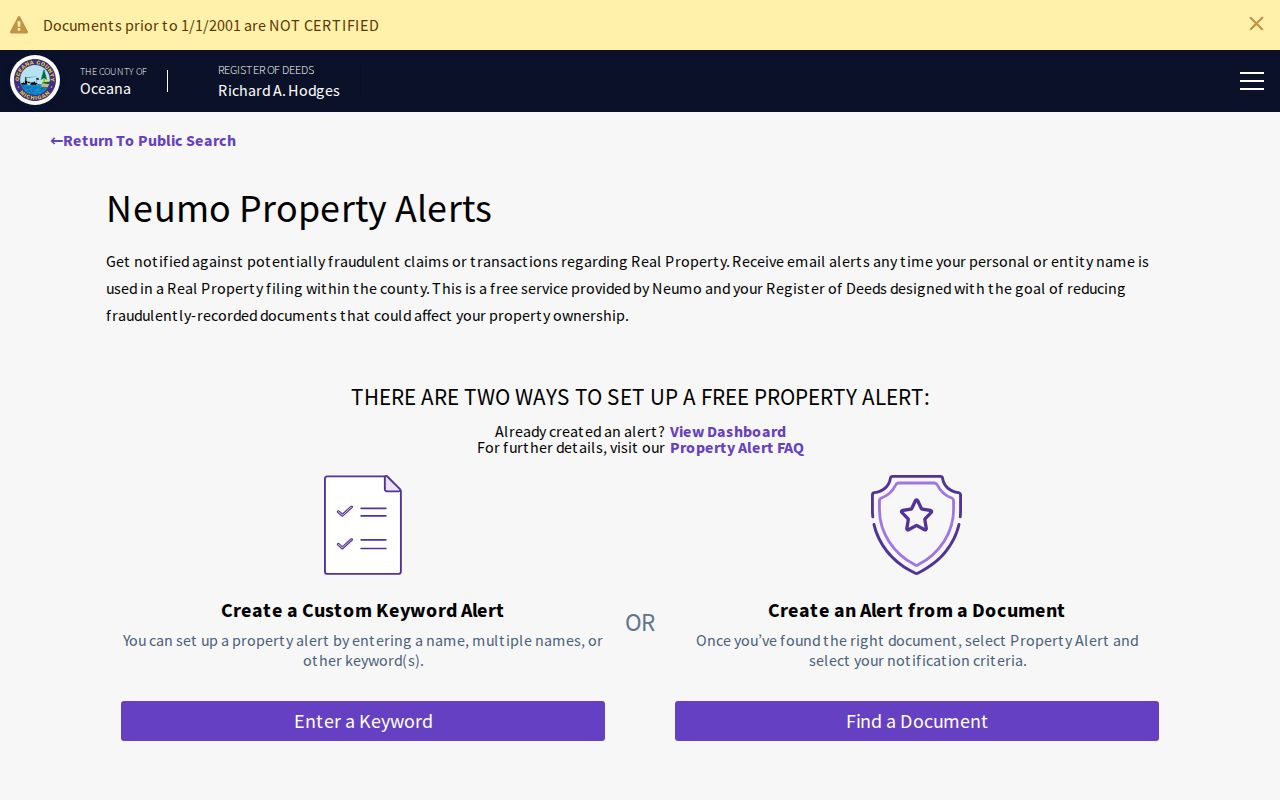
The official alert page shows how monitoring works. It flags new name filings in the deed records but never authenticates the matched document itself.
Request an Oceana County Deed Copy
Use online image controls where available, or request the deed from the Oceana Register of Deeds. The office is at 100 N. State Street, Suite M-3, P.O. Box 111, Hart, MI 49420; 231-873-4158; Monday through Friday, 9 a.m. to 5 p.m. The county documents counter and mail service, recommends calling first, and asks mail requesters to include a self-addressed stamped envelope.
Give the instrument number or book/page when known. Otherwise include the party names, property description, approximate date, copy type, page count if known, return details, and payment. No stable fillable copy-order form was found, so confirm current charges before mailing.
Recorded, not guaranteed. Oceana County deed records show instruments accepted for recording. The index is not a title opinion, and an unrecorded or misindexed interest may exist.
Preserve an Oceana Deed Search Audit Trail
Document every step of an Oceana County deed records search. Save the source URL first. Save the date you searched, the certification date shown, and the exact spelling of each party name. Write down the party role. Note any filters, the date range, the result count, and every document you opened. If the web index lets you down, the Register of Deeds still has options. Call the office, visit in person, or mail a detailed written request. For an administrative record with no other path, file a narrow county FOIA request.
Keep index facts and image facts separate. An index row may show a subdivision name that helps locate the record. But the scanned legal description holds the recorded language. That separation lets another reader repeat your Oceana County deed records search honestly. A negative online result never proves a deed is missing.
Older chains often run past the public portal. Gather the last confirmed book, liber, and page. Take the party name and legal description with them to the Register's counter. The Library of Michigan and Archives of Michigan hold historical plats and related county material. Treat archive clues as leads until a recorded instrument confirms the chain of title.