
Reconstruct Oceana Former Owners Transfer by Transfer
A backward chain starts with a verified current deed. From there you step through each predecessor instrument. Every row must show a real transfer, not a guess built on a shared surname or street, so use the parcel and full legal description to test continuity.
| Transfer date | Grantor to grantee | Deed type | Book/page or instrument |
|---|---|---|---|
| Newest matching date | Grantor on the current deed to its grantee | Indexed deed type | Public Search instrument or book/page |
| Earlier acquisition date | Prior owner to the later grantor | Warranty, quitclaim, fiduciary, court, sheriff, or tax deed | Matched legal description and prior reference |
| Earlier book entry | Predecessor grantor to predecessor grantee | Deed or related probate instrument | Register deed book, index card, or microfilm clue |
| Context date | Name tied to the same land | Plat, tax receipt, probate, or rural-property inventory | Archives or library lead awaiting deed confirmation |
Fill the first row from the latest recorded deed. The next row comes from the older acquisition deed in which that grantor took title. One transfer at a time, the chain assembles. Warranty, quitclaim, fiduciary, court, sheriff, and tax deeds each signal a different kind of transfer, so preserve the indexed document type instead of labeling every event a sale.
Walk the Oceana County Deed Chain Backward
The advanced Oceana Public Search separates grantor from grantee. Recorded dates, document types, document numbers, book or liber and page, and legal-search modes each get their own controls. Run every name variant you can imagine. When the legal description or a party's capacity matters, open the image itself rather than trusting the index line.
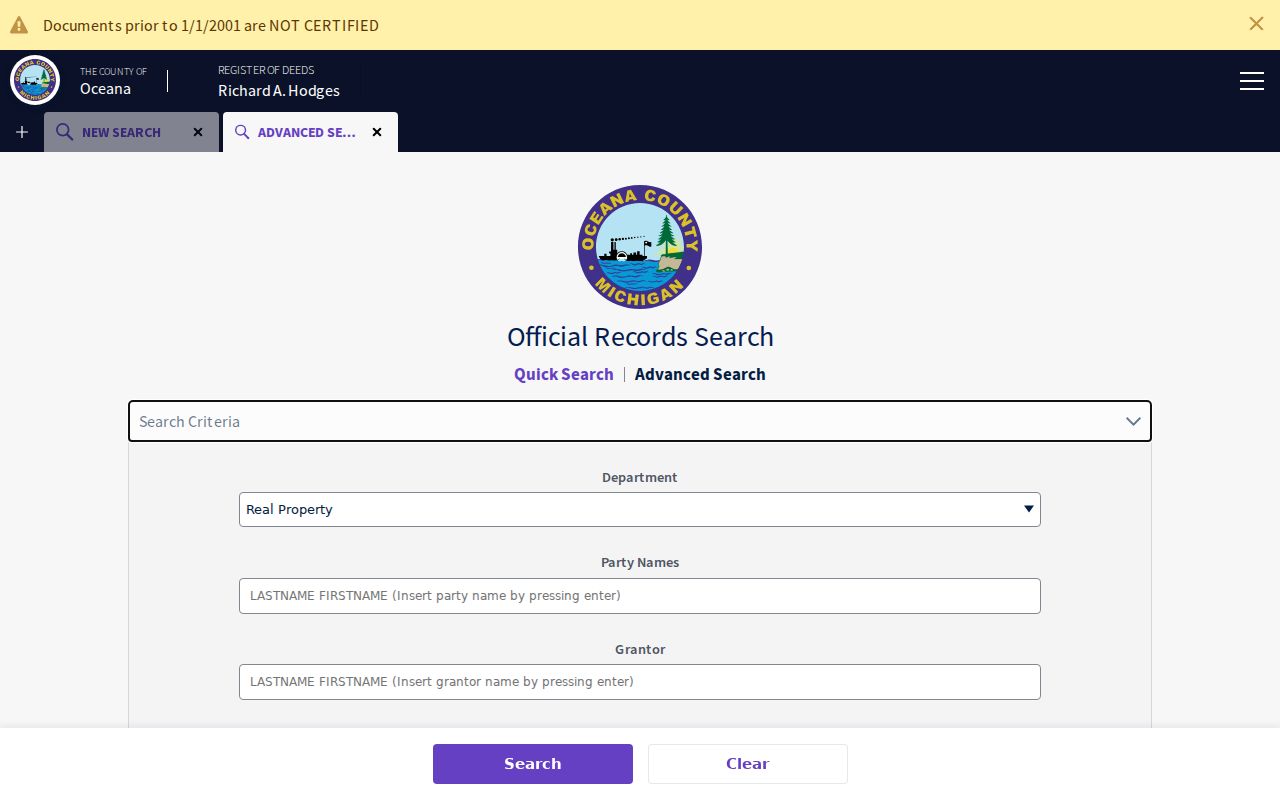
A surname alone is not enough. That is why a chain note should retain the party, book and page, document type, and the legal-search criteria behind every step back through the deed records.
- Open the current deed and record grantor, grantee, capacity, legal description, recorded date, and prior reference.
- Search that grantor as an earlier grantee, using spouse, initials, trust, estate, and entity variants.
- Match the older deed by land description, not name alone, and add it to the timeline.
- Repeat until the online trail ends, then carry the last book/page or index-card clue to the Register.
- Grantor / grantee
- The party conveying an interest and the party receiving that recorded interest.
- Chain of title
- The ordered sequence of instruments connecting prior owners to later owners.
- Legal description
- The land description used to match old instruments when a street address has changed.
Bridge Oceana Estates, Splits, and Names
Some bridges between former owners look nothing like a sale. A probate order or fiduciary deed can move title just as cleanly. So can a death certificate, trust instrument, correction, or land contract. Search both parties. Search every document group too. When the legal description changes, pause. Look for a split, conjoining, plat, easement, or boundary agreement. Then step back to an older owner.
Older parent parcels can linger in deeds long after the assessor assigns a child number. Set the old and new descriptions side by side. Ask Equalization for parcel-history records when the fit stays unclear. Never modernize historic wording silently.
Use Oceana County's Historic Place Language
Oceana County's land vocabulary has shifted over the generations. Early records lean on waterways, timber sites, and township references. Later ones use plats, parcel IDs, and uniform street numbers. That shift matters for any property search. The county seat moved to Hart in 1864. The first courthouse dated to 1874, and the present courthouse was occupied in 1958. One ownership chain may therefore cross record formats and repositories.
The Library of Michigan Oceana guide, the Archives of Michigan county guide, local newspapers, atlases, plats, tax receipts, probate files, and rural-property inventories can supply old spellings. They also offer place clues. Treat them as context. A place clue or surname spelling can reopen a stalled deed search. Each lead stands only until an official deed image or original record confirms it.
Carry Oceana Owner Trail into Archives
The online index is one layer only. Beneath it sits a deeper historical trail. The Archives of Michigan Oceana guide identifies 1856 through 1878 tax receipts and 1936 through 1942 rural-property inventories among its county holdings, alongside census, cemetery, county, and local-government materials. The Library of Michigan lists maps, plats, atlases, post-office histories, newspapers, and county histories. Any of these can restore a place name, a surname spelling, an occupation, or a property description the deed search needs.
Newspaper coverage is uneven across the county. Record the title and issue date for every lead. Oceana County Journal holdings run from 1869 through 1882. Pentwater News reaches from 1872 into 1961 with gaps. Hart Journal holdings include 1882 through 1892, 1907 through 1969, and 1976. The Hart Area Public Library digital archive covers Herald-Journal material from 1888 through 2005.
Search former-owner surnames with terms such as plat, probate, administrator, tax sale, vacated, orchard, or right of way. Then return to the official instrument. A newspaper or atlas can point. It cannot prove title.
Note: A newspaper, atlas, tax receipt, or genealogy file is a lead until the same land and party are confirmed in an official record.
Bridge Oceana County Plats to Modern Addresses
Old ownership chains often follow land language that outlasts any street number. Pentwater materials reference Block 42, Block 53, Block 119, and Plat D. They also cite vacated Fourth and Ellery Streets. An older deed may match a current parcel through its block, lot, plat, road-vacation, or easement. The modern address may produce no useful index hit. Start with the original plat. The plat remembers what the street forgot. Compare it with current GIS, then search the Register for the vacation or access instrument. The address is a latecomer.
Oceana County adopted its uniform-numbering system in November 1991. A permanent address can follow a township zoning permit and an Equalization Building Location Form. Still, that administrative address never replaces the legal description. Prior owners may vanish at an address change. Keep both the old phrase and the current parcel ID. Then search Freeform Legal, Subdivision Legal, Section Legal, and Condo Legal modes. Choose the mode the description requires.
Continue Oceana Former-Owner Searches Offline
The Register of Deeds stays the custodian whenever an online chain hits a gap. That gap may sit in the index or the images. Come with the last owner of record name, an approximate date, and the exact legal phrase. Bring the document type and the book or liber and page number. The office sits at 100 N. State Street, Suite M-3 in Hart, open Monday through Friday from 9 a.m. to 5 p.m. It serves walk-in researchers and mail copy requests alike. A call to 231-873-4158 settles copy types, payment, and return-envelope rules before anything goes in the mail.
A good question for staff asks whether the next former owner appears in a deed book or index card. The same question covers microfilm runs, original plats, or another permanent land record. A citation works even without an image. Keep it and order the official copy that fits the purpose at hand. An archive or library lead travels best when paired with the historic township, subdivision, block and lot, road name, or party spelling. A current street address alone will not do.
When a missing public county file lies outside the deed index, the county FOIA page serves as the fallback. Name the office, the parcel, the record category, and the date range. Michigan FOIA allows a five-business-day response and a written ten-business-day extension. Charges stay limited to actual search, review, separation, copying, and mailing work.
How Far Back Oceana Owners Go
The portal's search boundary reaches back to January 1, 1800. That is the earliest date the system accepts. It is not proof that every deed from 1800 forward is online. The Register states no exact first indexed or imaged year. The quick index carries a certification date of August 31, 2026.
Online former owners eventually stop. Take the last known name, date range, subdivision or legal phrase, and book/page to the Register of Deeds. The office serves visitors and mail requests at 100 N. State Street, Suite M-3, Hart. Older work may require deed books. It may also require index cards, microfilm, an archive visit, or a directed request. One caution on wording matters. Say "no online indexed result located in the searched range." Never claim "no deed exists."
Online cutoff caution. The 1800 portal floor does not establish complete coverage; older or missing former owners may remain in deed books, index cards, microfilm, or archives.
Lawful use. Former-owner research supports house history, estate work, and property diligence. Never use a historic chain or a related address to track, intimidate, or harass a living person.